Having Enough Saved Is Not the Same as Having a Retirement Plan. Here's the Difference.
Jun 12, 2026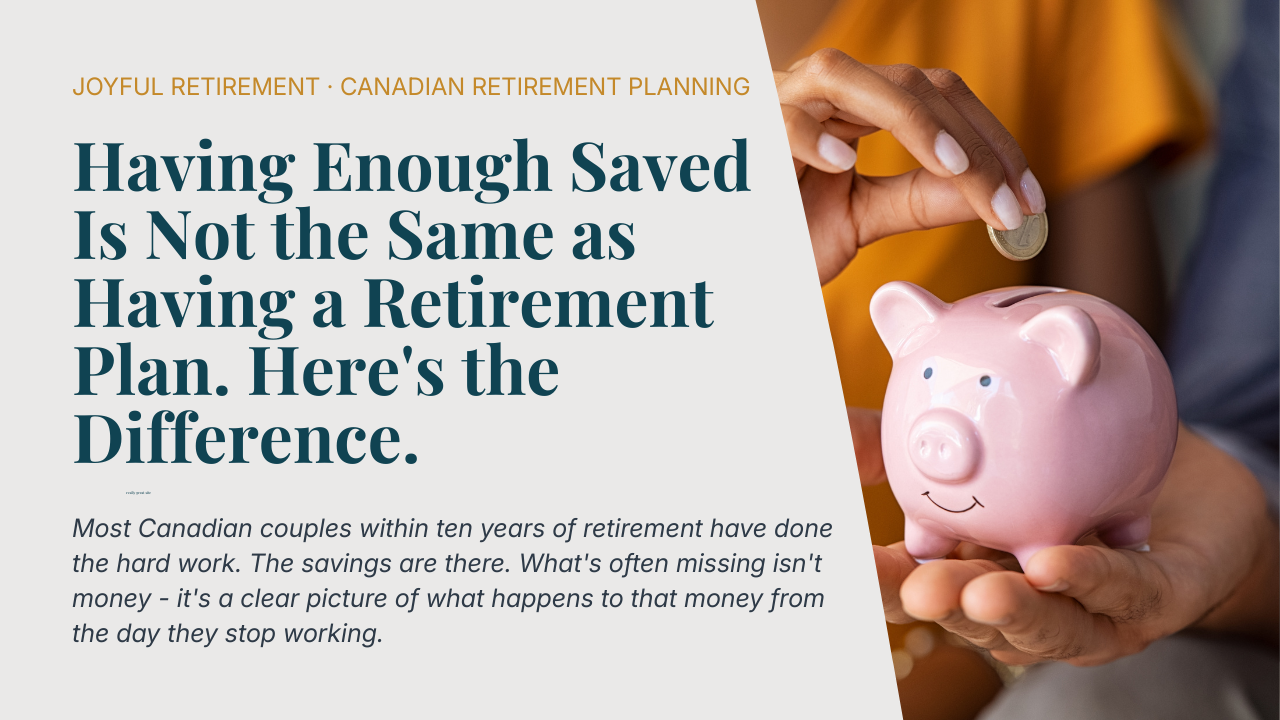
Most Canadian couples within ten years of retirement have done the hard work. The RRSPs were funded through mortgage years and tuition years. The TFSAs came later, but they came. By any reasonable measure, the saving - the part that took four decades of discipline - is done.
And yet ask those same couples how retirement will actually work, month by month, and the confidence thins out fast. Which account gets drawn first? When does CPP start, and why that year? What changes at 71? What does the picture look like for whichever of you is left to manage it alone?
That hesitation isn't a savings problem. It's the difference between having money and having a plan and it's worth understanding precisely, because the two get confused all the time.
Saving is a habit. Retiring is a set of decisions.
Accumulation rewards simple behaviour repeated for decades: spend less than you earn, contribute automatically, don't panic when markets fall. The skills that built the nest egg are habits.
Decumulation - turning savings into income - is a different discipline entirely. It's a sequence of interlocking decisions, many of them one-time and some of them irreversible: when each partner starts CPP, whether OAS is deferred, what order the accounts are drawn in, when the RRSP converts, whose age sets the RRIF minimums, how income is split between two tax returns. A strong saver can be a poor decumulator, not through any failing, but because nothing in forty years of saving ever required these decisions before.
The questions a savings balance can't answer
Which account gets drawn first. RRSP, TFSA, and non-registered money are taxed in completely different ways, and the order they're spent in can change a couple's lifetime tax bill by tens of thousands of dollars. The same balances, drawn in a different sequence, produce a different retirement.
When government benefits start. CPP taken at 60 versus 70 differs by more than double the monthly amount, permanently. OAS carries a 36% deferral bonus and a clawback threshold ($95,323 in 2026). These are six-figure timing decisions for a couple and a savings balance is silent on all of them.
What happens at 71. Every RRSP must close by the end of the year its owner turns 71, and mandatory RRIF withdrawals follow, starting at 5.28% and rising every year for life. Without a drawdown plan in the sixties, those forced withdrawals decide a couple's tax brackets in the seventies and eighties on the government's schedule instead of yours.
What the survivor's finances look like. At some point, almost every couple's plan becomes one person's plan. The survivor typically inherits two streams of RRIF income on a single tax return, a capped CPP survivor benefit that's smaller than most people assume, and sole responsibility for decisions that may have always lived with the other partner. A real plan is built for three phases: both of you, the survivor, and the estate.
Whether the paperwork matches the intentions. Beneficiary designations, wills, and powers of attorney decide what actually happens to the money and they routinely lag years behind reality. A seven-figure portfolio with an outdated beneficiary form is not a plan; it's a dispute waiting for a filing date.
Whether both partners see the same picture. Two people can share accounts for thirty years and quietly hold different retirements in their heads, different start dates, different spending, different assumptions about who handles what. The gap usually surfaces at the worst possible moment. Alignment is a planning task, not a personality trait.
Why the mistakes are so quiet
Run out of money and you'll know. But the costs of having savings without a plan rarely look like that. They look like tax that didn't need to be paid, an OAS clawback that a different withdrawal order would have avoided, a CPP start date chosen by default, an estate bill that planning at 65 could have halved. No statement ever shows the line item. The money is simply gone, and the couple never feels the difference, which is exactly why the difference can grow so large.
What a real retirement plan looks like
Not a binder of projections — a set of answered questions:
- An income plan: which dollars arrive from which account, in which years, and why.
- A tax map through age 71 and beyond, including the low-income window many couples have in their sixties, when deliberate RRSP withdrawals are cheapest.
- CPP and OAS start dates chosen on purpose, coordinated as a couple, with the survivor math run both ways.
- An estate layer that matches current intentions: beneficiaries, wills, and powers of attorney that have been read recently, not just signed once.
- Both partners able to explain the plan because one of you will eventually have to run it alone.
Notice what's missing from that list: a bigger number. Most couples close to retirement don't need more money. They need the money they have to be pointed at decisions instead of sitting behind a question mark.
Find out which one you have
There's a fast way to tell whether what you have is a plan or a balance. The Canadian Retirement Readiness Score is a 20-minute self-assessment built for couples within ten years of retirement — 40 questions across eight areas, from CPP timing and RRIF strategy to estate documents and couple alignment. Couples who complete it honestly almost always find gaps. That's not the bad news; finding them now is the entire point.
And when the gaps are on the table, book a Retirement Clarity Call at joyfulretirement.ca — a focused conversation with a registered financial advisor about turning what you've saved into a plan you can both explain.
Educational content only. Not personalised financial, tax, legal, or investment advice. Joyful Retirement is a retirement education company, not a registered financial advisory firm. Figures cited are current as of mid-2026 and subject to change; confirm current amounts at canada.ca. For advice specific to your situation, consult a qualified financial advisor or tax professional.